Harsh Doesn't Mean Untrue
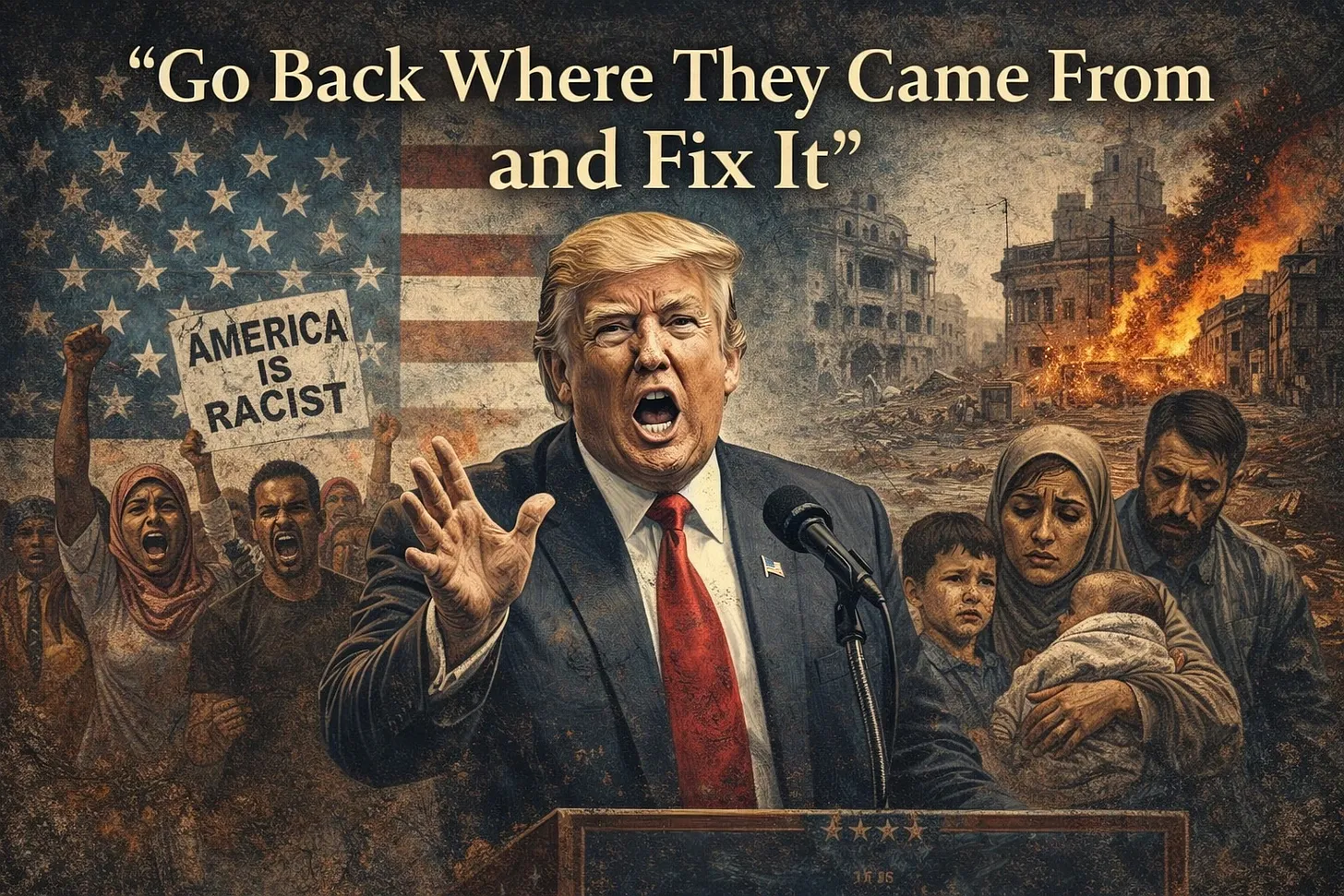
In 2019, then–President Donald Trump made a remark that quickly became infamous. Responding to criticism from several progressive lawmakers, he suggested they should “go back and help fix the totally broken and crime infested places from which they came.” The comment was widely condemned as racist. It was crude, imprecise, and rhetorically abrasive, flattening individual lives into caricatures of nations and inviting the worst interpretations.
Yet bad rhetoric does not automatically negate every underlying claim. Sometimes it obscures a difficult truth rather than inventing a false one. And six years later, the cultural question buried beneath that controversy remains not only unresolved, but more urgent than ever.
The real issue was never race. It was culture, specifically, whether the moral and philosophical foundations that made America successful can survive if they are no longer understood, taught, or respected.
America as an Idea Before a Place
America did not become prosperous or free by accident. Nor did it succeed merely because of geography, resources, or military power. From its earliest self-understanding, the American project was grounded in ideas about the human person.
The Declaration of Independence famously grounds political legitimacy not in ethnicity or tradition, but in a moral claim: that “all men are created equal” and “endowed by their Creator with certain unalienable Rights.” This was not a statement of achieved reality, but of philosophical commitment. One that would take generations to work out in law and practice.
Alexis de Tocqueville, observing America in the 1830s, noted that its success rested not primarily on laws or economics, but on moral habits and beliefs. “America is great because she is good,” he wrote, “and if America ever ceases to be good, America will cease to be great” (Democracy in America, Vol. I, Pt. II, Ch. 9). What he meant by “good” was not moral perfection, but a shared understanding of duty, restraint, and individual responsibility embedded in civil society.
In theological language, this moral vision drew heavily from the Biblical concept of Imago Dei . The belief that human beings possess inherent dignity because they bear the image of God (Genesis 1:27). In political language, it became natural rights theory, articulated by thinkers like John Locke, who argued that liberty rests on the moral equality of persons, not on power or permission (Second Treatise of Government, §§4–6).
Nations, then, are not merely collections of people within borders. They are moral ecosystems. Some ecosystems generate trust, innovation, and ordered liberty. Others generate corruption, instability, or coercion. Acknowledging this is not prejudice; it is historical observation.
Immigration, Assimilation, and Gratitude
For most of American history, immigration succeeded because it paired opportunity with expectation. Newcomers were welcomed into a society that was imperfect but aspirational, and they were generally expected to assimilate into its civic culture.
Historian Oscar Handlin famously wrote that “once I thought to write a history of the immigrants in America. Then I discovered that the immigrants were American history” (The Uprooted, 1951). But becoming American meant learning its language, adopting its civic norms, and participating in its moral project.
Frederick Douglass, himself a former slave, understood this distinction clearly. While he was among America’s fiercest critics, he was equally one of its most passionate defenders of its founding principles. In his 1852 address, What to the Slave Is the Fourth of July?, Douglass condemned America’s failures while insisting that the Constitution and Declaration contained the moral tools for reform. He criticized hypocrisy, not the principles themselves.
Gratitude, in this sense, was not blind loyalty. It was recognition that the framework itself, however imperfectly applied, was uniquely capable of self-correction.
Today, that moral narrative has weakened. Not because immigrants are worse people, but because America itself has grown uncertain about how to explain why it works. Rights are emphasized without the philosophical soil that sustains them. Grievance is incentivized more than responsibility. Criticism is detached from historical context. All the while, our educational instutions, media pundits and political leaders devote their every waking moment to inject grievance poison into the national bloodstream.
As political philosopher Michael Novak observed, democratic capitalism and liberal democracy more broadly depends on “a moral-cultural system that it cannot itself produce” (The Spirit of Democratic Capitalism, 1982). When that system erodes, entitlement replaces gratitude, and participation gives way to resentment.
Why “Racism” Is the Wrong Lens
Labeling this concern “racist” misunderstands the argument and weakens the possibility of genuine integration.
First, it collapses culture into race, an error long rejected by serious thinkers. Culture is learned, transmitted, and revised; it is not genetic. Confucianism, Christianity, liberalism, and Marxism have crossed ethnic boundaries repeatedly across history.
Second, it shields ideas from scrutiny. John Stuart Mill warned that a society unwilling to challenge its own assumptions would stagnate intellectually and morally (On Liberty, Ch. II). Treating cultural critique as moral taboo does not promote harmony; it prevents course correction.
Third, it undermines assimilation. As historian Samuel Huntington argued, successful immigration requires a clear sense of national identity. “Without assimilation,” he wrote, “America becomes a collection of peoples with different languages and cultures” (Who Are We?, 2004). That concern is not about exclusion. It is about cohesion.
The Deeper Failure: Moral Amnesia
The deeper problem exposed by the 2019 controversy was not Trump’s rhetoric alone, but America’s loss of confidence in its own moral center.
James Madison warned that free government depends on more than institutional design. “A dependence on the people is, no doubt, the primary control on the government,” he wrote, “but experience has taught mankind the necessity of auxiliary precautions” (Federalist No. 51). Those precautions assume a citizenry shaped by virtue and restraint.
When a society forgets why it works, it cannot teach newcomers what it expects. Immigration into a morally amnesiac nation becomes not integration into a tradition, but immersion into a vacuum.
And vacuums are always filled. By grievance, ideology, or power.
A Necessary Distincti
The distinction Trump failed to articulate but which remains essential is this:
Criticizing anti-American ideologies is not the same as criticizing immigrants.
One can affirm the dignity of every person while recognizing that not all cultural frameworks produce liberty, trust, or prosperity. Pope John Paul II, reflecting on human dignity, emphasized that freedom must be oriented toward truth or it collapses into self-destruction (Centesimus Annus, §46).
Welcoming newcomers while expecting respect for the moral architecture of the society they join is not exclusionary. It is the only way pluralism, and indeed a nation itself, survives.
Moral Clarity Is Not Cruelty
America does not need less compassion. It needs more clarity.
Compassion divorced from truth becomes indulgence. Truth divorced from compassion becomes cruelty. A free society requires both.
One may think Trump’s words in 2019 failed because they were careless and accusatory. But dismissing the underlying cultural question as “racism” avoids the harder conversation, one America can no longer afford to postpone.
If a nation cannot articulate the principles that made it worth coming to, it cannot expect anyone to help preserve them. And if those principles erode, no amount of moral signaling will save what remains.